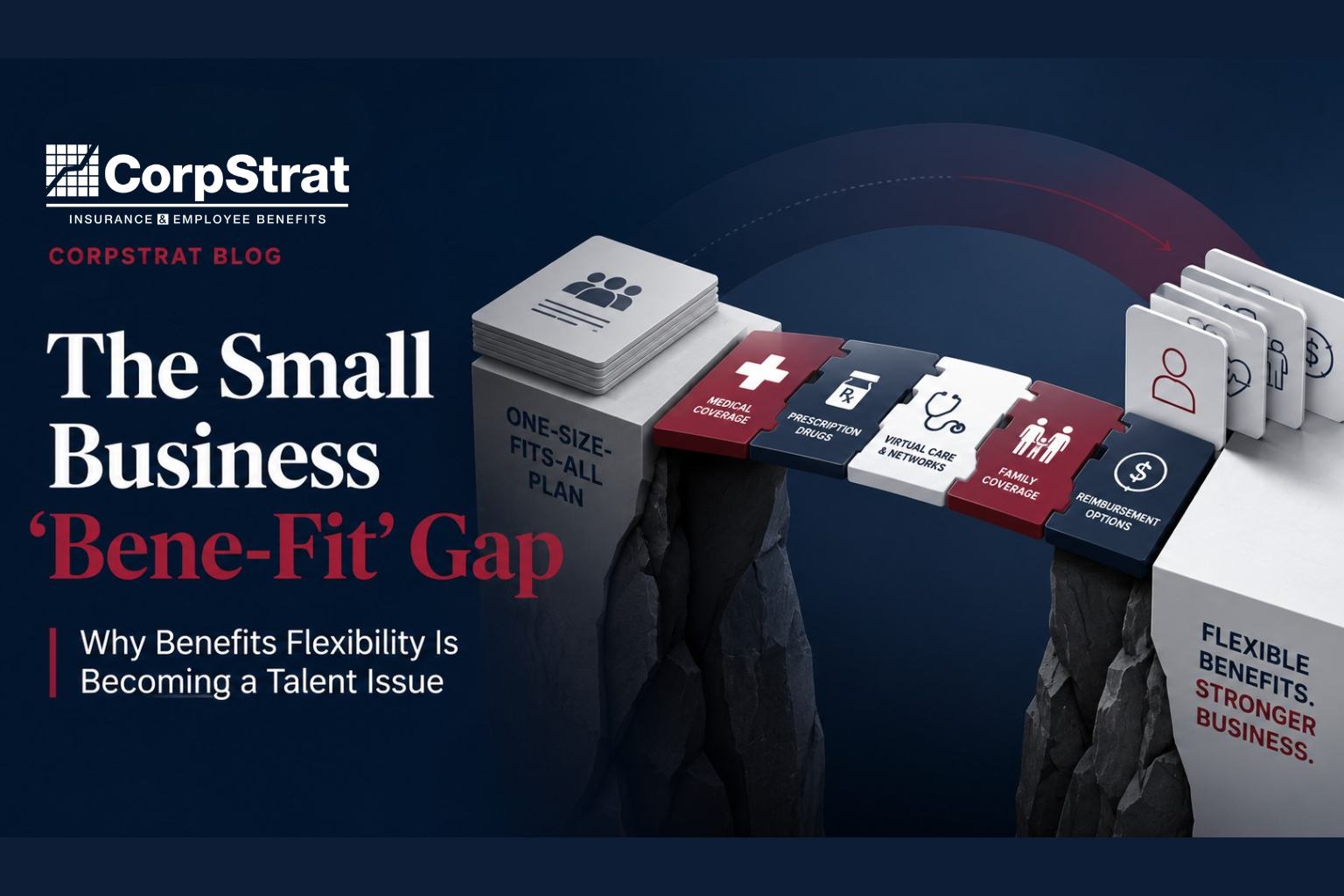
Today’s workforce is no longer one-size-fits-all, but many small businesses still feel forced into offering one-size-fits-all health benefits.
Small businesses face a familiar dilemma. Rising healthcare costs demand predictability, while increasingly diverse employee needs demand greater choice.
With employees working across different locations and navigating different healthcare needs, family situations, doctors, prescriptions, and provider networks, a single health plan may not work equally well for everyone.
Research commissioned by Justworks and conducted with The Harris Poll examines how small business decision-makers and employees view health benefits. The findings reveal a growing disconnect between what employers want to provide and what employees expect from their coverage.
For growing businesses competing against larger organizations for talent, benefits flexibility is becoming more than an HR preference. It is increasingly connected to recruitment, retention, and the overall employee experience.
Key Findings
Small businesses are not struggling because they do not care about employee benefits. Many are struggling to find coverage options that fit modern teams while remaining financially and operationally manageable.
Key findings from the report include:
- Half of small business decision-makers are concerned about how their current benefits may affect hiring and retention.
- Among those concerned about talent, eighty percent say it is difficult to find a health benefits solution that works for employees with different needs.
- Ninety-six percent of talent-concerned decision-makers say offering employees more choice in their health coverage is important.
- Eighty-nine percent of small business decision-makers say providing employees with more healthcare choice is important.
- Eighty-six percent of employees say flexibility in choosing their health insurance provider matters when evaluating a job offer.
- Eighty-seven percent of employees would consider working for a small business that provides a monthly reimbursement so they can select their own health insurance coverage.
The Growing “Bene-Fit” Gap
For years, conversations about employee benefits centered on one primary question:
Can the business afford to offer health insurance?
That question still matters. Cost and affordability remain the biggest health benefits challenge for many small businesses, with thirty-four percent of decision-makers identifying it as their leading concern.
However, employers are now facing a second question:
Even when we offer health insurance, does it work for everyone on the team?
According to the research, fifty-two percent of small business decision-makers worry at least quarterly that their current health benefits may not fully meet their employees’ needs.
That concern is even higher among businesses with twenty-five to ninety-nine employees.
Nearly half of small businesses are also concerned that their current benefits offering could make it harder to recruit or retain employees. Only fifty-five percent believe that a single employer-provided health plan can realistically meet the needs of everyone on their team.
Employees are expressing similar concerns from the other side of the hiring process.
Eighty-six percent say the ability to choose their health insurance provider is important when evaluating a job offer. Eighty-seven percent would consider joining a company that offered a monthly reimbursement to help them select coverage based on their own doctors, prescriptions, networks, and healthcare needs.
This disconnect is what the report describes as the “Bene-Fit” Gap: the difference between what employers want to provide and what employees need from their benefits.
Benefits Flexibility Is Becoming a Talent Gap
Growing companies have always competed for qualified employees. What has changed is what employees expect from the companies they join.
Nearly half of small business decision-makers are concerned that their benefits offering could make hiring or retaining talent more difficult.
Among this group:
- Eighty percent say it is difficult to find a benefits solution that works across different healthcare needs, family situations, and employee locations.
- Ninety-six percent say offering employees more choice in their health coverage is important.
- Forty-two percent say rising healthcare costs are causing them to reconsider how they provide benefits.
The problem is not a lack of employer concern.
Many business leaders recognize the importance of competitive benefits but may not feel they have enough tools, information, or coverage models available to address the different needs within their workforce.
Employees Want Benefits That Fit Their Lives
Employees are increasingly evaluating benefits based on how well the coverage fits their personal circumstances.
Among small business decision-makers:
- Eighty-nine percent say offering employees more choice is very or somewhat important.
- Fifty-nine percent say finding a solution that works for different employee needs is difficult.
- Forty-four percent say having more plan choices would make them more likely to offer or improve employee benefits.
- Twenty-seven percent say the greatest advantage of having access to multiple coverage models is being able to find the right fit for a diverse workforce.
When an Individual Coverage Health Reimbursement Arrangement, or ICHRA, was described to employees, the most appealing features included flexibility and the ability to choose coverage based on individual doctors, networks, and prescriptions.
An ICHRA allows an employer to provide a defined amount of money that eligible employees can use to purchase their own individual health insurance coverage.
Thirty-six percent of surveyed employees valued the ability to use remaining eligible funds toward healthcare expenses such as therapy or contact lenses. Thirty-three percent valued having greater choice based on their doctors, provider networks, and prescription needs.
The findings do not suggest that traditional group plans are no longer valuable.
Traditional employer-sponsored coverage remains an effective solution for many organizations. However, the data indicates that employees and employers are increasingly open to different approaches when a single group plan does not adequately serve the entire workforce.
Personalization Is Becoming an Employee Expectation
Employees are not necessarily rejecting employer-sponsored health benefits. Instead, many are looking for greater control over how those benefits are structured.
When asked how they would prefer employer-provided health benefits to work:
- Thirty-three percent were open to either an employer-selected plan or an employer-funded individual model, depending on quality and cost.
- Twenty-nine percent preferred an employer-selected plan or set of plans.
- Twenty-seven percent preferred receiving a set monthly amount to choose their own coverage.
This suggests that there is no single model that works for every employee or every business.
Some employees may prefer the simplicity of a traditional group plan. Others may place greater value on selecting coverage that includes their preferred doctors, medications, and provider networks.
The most effective benefits strategy may depend on the organization’s workforce, location, budget, participation levels, and long-term business objectives.
What Employers Should Consider
The research points to a broader shift in how small businesses may need to approach employee benefits.
Workers want more choice. Employers want to provide meaningful coverage. The challenge is finding a structure that balances flexibility, affordability, compliance, and administrative responsibility.
Before making changes, employers should evaluate:
- Whether the current plan is meeting employee needs
- How employees are distributed geographically
- Whether employees are using different doctors, provider networks, and prescriptions
- The predictability of the company’s healthcare spending
- Employee participation and eligibility requirements
- The administrative responsibilities associated with each benefits model
- How benefits affect recruitment and employee retention
The goal is not necessarily to replace traditional group coverage.
The goal is to understand whether the current strategy remains the most appropriate fit for the business and its employees.
CorpStrat Insight
The growing demand for benefits flexibility does not mean every company should immediately move away from traditional group insurance.
It means employers should stop assuming that one benefits structure will automatically serve every workforce.
Traditional group plans, level-funded arrangements, defined-contribution strategies, and individual coverage reimbursement models can each serve different business needs. The right approach depends on the company’s size, employee demographics, locations, budget, risk tolerance, and long-term hiring strategy.
Employers should also be careful not to evaluate health benefits based only on the annual renewal increase.
A plan that appears affordable but does not meet employee needs may create hidden costs through low participation, employee dissatisfaction, recruitment challenges, and turnover.
At the same time, providing more choice without a clear strategy can create confusion and additional administrative responsibility.
The strongest benefits strategy is not necessarily the plan with the lowest initial price or the greatest number of options. It is the one that creates the right balance between cost control, employee choice, plan quality, and operational simplicity.
CorpStrat helps employers evaluate these tradeoffs, compare available funding and coverage models, and build a benefits strategy aligned with both workforce needs and business objectives.
Source
This article references research published by Justworks in “The Small Business ‘Bene-Fit’ Gap Report,” dated July 9, 2026. The research was commissioned by Justworks and conducted with The Harris Poll.
Reference: Justworks, The Small Business “Bene-Fit” Gap Report.