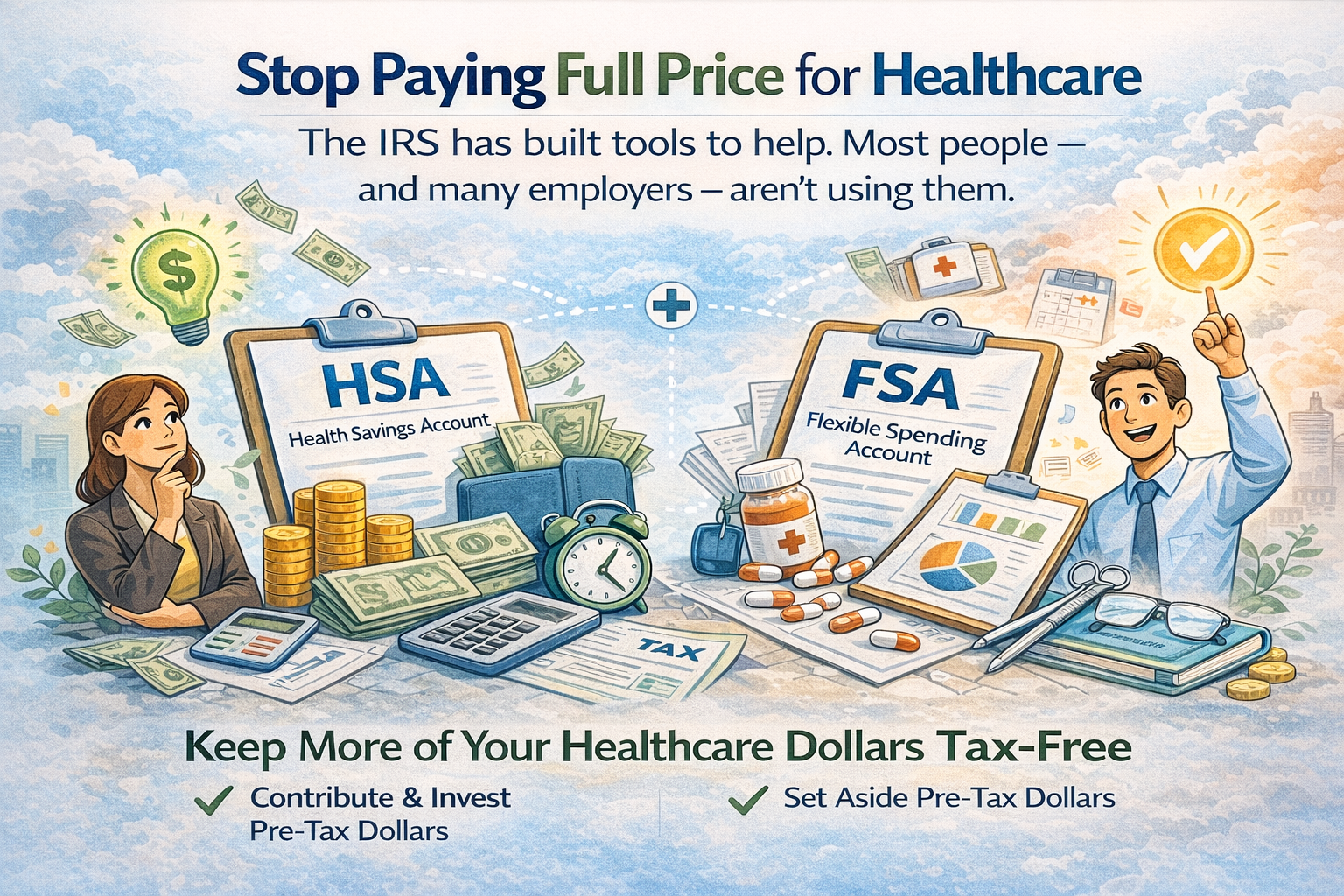
The IRS has built tools to help. Most people and many employers aren’t using them.
Whether you’re a business owner trying to do more for your team, or a professional paying too much out of pocket for care your insurance barely touches there are legitimate, IRS-approved ways to make your healthcare dollars go further.
Here’s the short version.
If You’re an Employee or Self-Employed Professional
Health Savings Account (HSA) — The one most people underuse. If you’re enrolled in a high-deductible health plan, you can contribute pre-tax dollars to an HSA and spend them tax-free on medical expenses. The money rolls over every year and can be invested. It’s the only account in the tax code with three tax breaks: deduction going in, tax-free growth, tax-free withdrawals for medical costs.
2025 limits: $4,300 individual / $8,550 family. If you’re 55+, add $1,000 more.
Flexible Spending Account (FSA) — If your employer offers one, you set aside pre-tax dollars each year to cover predictable expenses: copays, prescriptions, dental, vision, and more. Simple, automatic, and an immediate tax discount on spending you’re already doing. And, you don’t have to fund this account all at once, or in entirety.
What both accounts cover that surprises most people: out-of-network charges, specialty medications, chiropractic care, hearing aids, LASIK, orthodontia, and more all eligible expenses under IRS Section 213. Want to deduct more out of pocket expenses, this is a great tool.
If You’re a Business Owner or Employer
Health Reimbursement Arrangement (HRA) — Employers fund this; employees spend it tax-free. No premiums, no network. You reimburse employees for qualifying medical expenses, take the deduction, and they receive the benefit free of income and payroll taxes.
Executive Medical Reimbursement Plan — This is the one almost nobody talks about – and most CPA’s are surprised still exist. A business can select specific employees even just one and cover virtually all of their out-of-pocket medical expenses through a supplemental reimbursement plan. The employer deducts it. The employee receives it tax-free. No payroll taxes on either side.
What makes it especially powerful: it bypasses the 7.5% of income floor that limits personal medical deductions on individual tax returns. Dollar one is tax-advantaged. And unlike standard group health benefits, this type of plan can legally be offered to a select group a key executive, a partner, or a top performer without extending it company-wide.
Covered expenses include essentially everything the primary plan doesn’t: deductibles, copays, out-of-network bills, dental, vision, hearing, chiropractic, specialty drugs, psychiatric care, and more.
One provider we work with, BeniComp Select, has offered this since 1962. Pricing is transparent: $350/year per participant, then claims plus 12%. No monthly premiums. No renewal increases. You pay for what you use.
The Bottom Line
Most people leave these benefits unused not because they’re complicated, but because nobody put them on the radar. A quick review of your current benefit structure can reveal real tax savings and real coverage gaps worth closing.