Everyone’s hunting for the same thing right now: a way to stop health insurance costs from climbing.
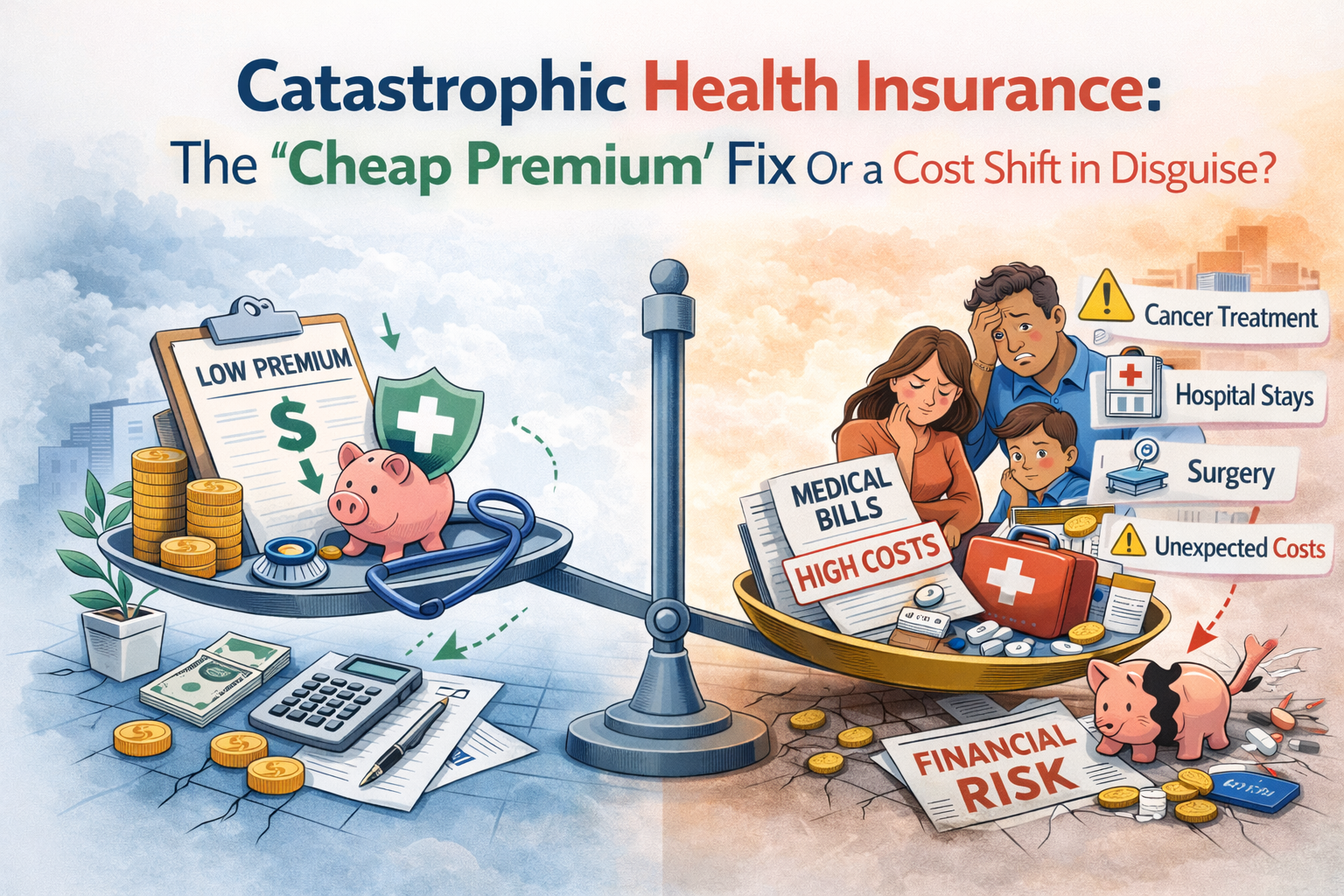
One idea getting renewed attention in Washington is expanding access to catastrophic health insurance plans for individuals plans with lower monthly premiums but very high deductibles. The appeal is obvious: if more people buy leaner coverage, premiums can look cheaper on paper. But there’s a tradeoff that’s easy to miss:
Catastrophic coverage doesn’t eliminate healthcare costs. What changes- who pays and when they pay?
What is “catastrophic” coverage, really?
A catastrophic plan is designed to protect you from financial ruin if something truly big happens think hospitalization, major surgery, cancer treatment, etc.
But until you hit the deductible, you’re mostly on your own.
Under ACA catastrophic plans, coverage typically doesn’t kick in until you reach the annual cost-sharing limit, though you typically do get Wellness covered before the deductible.
And those deductibles are not small. For 2026, reporting indicates catastrophic deductibles around $10,600 for an individual and $21,200 for a household.
What’s changing now: expanding access
Federal guidance announced in September 2025 broadened the ability for some people to qualify for a hardship exemption, which can open the door to catastrophic plan enrollment in 2026 especially for people who are not eligible for Marketplace subsidies based on income.
Also on the national radar: a proposed rule package for 2027 includes additional Marketplace changes and again highlights catastrophic plans as a lower-premium option, with a public comment window running into March 2026.
Why catastrophic plans will be cheaper
Premiums are largely driven by what the plan is expected to pay. So if a plan pays less—because the member pays more upfront the premium can drop. That’s the “math” behind why catastrophic plans are back in the conversation.
And yes, for someone who is healthy, has savings, and rarely uses care, that lower premium can feel like a win.
The part that matters: the cost shift is real
Here’s the core issue: serious claims are not rare and they are getting more intense.
National spending is extremely concentrated in a relatively small share of people each year:
- In 2022, the top 5% of people accounted for about half of total healthcare spending.
- The top 1% accounted for about 21.7% of total spending.
That means it’s not “one in a hundred” people driving the bulk of costs. It’s more like five in a hundred driving about half of all costs in a given year before we even get into how many more people have meaningful (but not top-5%) expenses.
And in employer plan data, the severity story is similar:
- One report notes ~1% of members exceeding $100,000 in annual claims yet accounting for ~33% of total spend.
- Another employer-market resource points to $1M+ claims increasing sharply over recent years.
So when we talk about “catastrophic,” we’re not talking about lightning strikes only. We’re talking about a healthcare environment where high-cost episodes and chronic, ongoing needs are a meaningful part of the risk pool.
Why this could reduce premiums… and increase financial stress
Catastrophic plans can reduce premiums in two ways:
- Cost sharing shifts to the patient (high deductibles and out-of-pocket exposure).
- Healthier people may gravitate to them, which can change the mix of who’s left in richer plans.
But those “savings” don’t necessarily mean the system got cheaper. Often it means:
- more people delaying care because they can’t afford the deductible
- higher bad debt / payment plans / financial strain
- more surprise when a family hits a $10k–$20k out-of-pocket year
In other words: lower premiums, higher “risk of a bad year.”
Conclusion:
Catastrophic health insurance may lower the monthly premium but it doesn’t lower the underlying cost of care. It simply shifts more of the financial responsibility to the individual at the moment they need care most. And in a healthcare environment where high-cost claims are no longer rare outliers but a growing reality, that shift matters.